
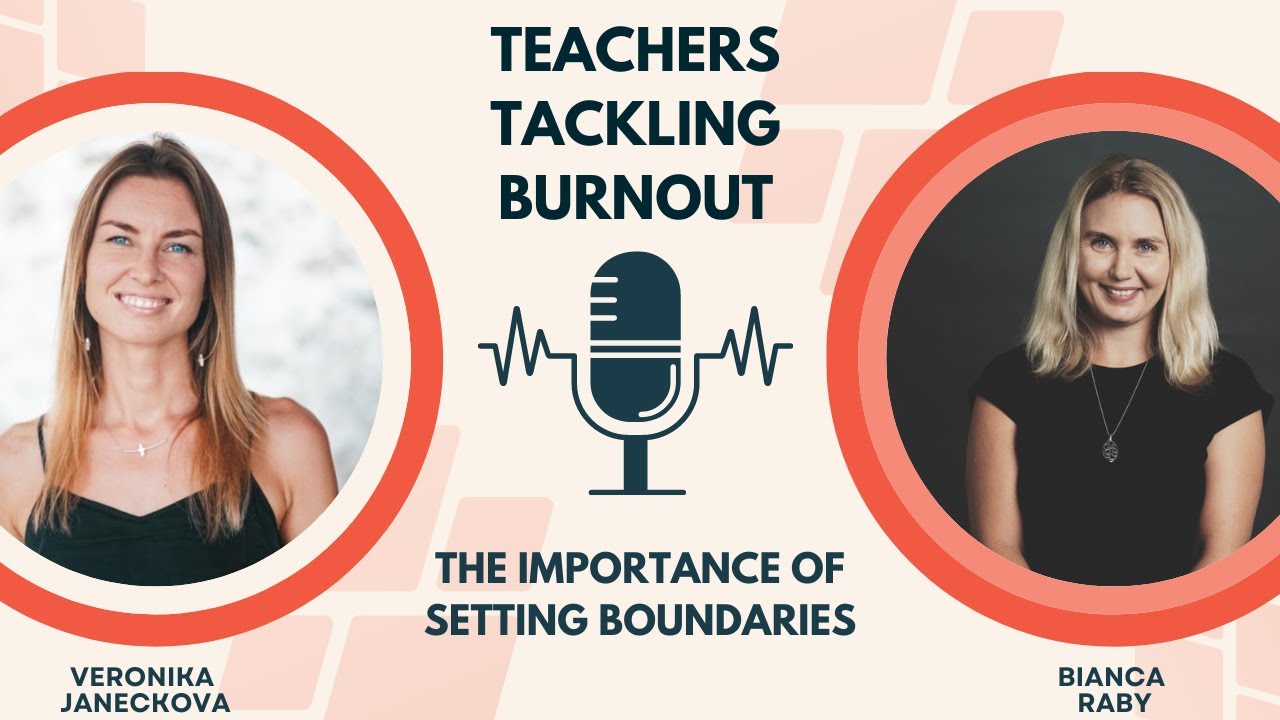
Teacher burnout and the struggle of time management with Veronika Janeckova
Let's be honest: if "teacher burnout" were a person, it would have its own office by now. And "time management"? That poor soul would be buried under a mountain of planners, PD slides, and colour-coded Google Calendars. In a recent conversation with Veronika Janeckova, we unpacked why teacher burnout is skyrocketing, why time management advice often falls flat for educators, and what needs to shift, within us and the system, to actually move forward.
And let me tell you, it's not about squeezing in a lunchtime meditation. Check out our full conversation here:
The stats on teacher burnout are alarming (but not surprising)
A HolonIQ report recently revealed that 44% of K–12 educators in the U.S. are experiencing teacher burnout. That's nearly half the workforce. And if you've worked in a school lately, you're probably nodding grimly, not gasping.
"It's huge," Veronika said. "It's not surprising for me, which doesn't mean it's a good thing. We're looking at environments with high regulation, low autonomy over time management, and massive emotional output." Not an education centre for kids, but a teacher burnout factory for us.
Pair that with professions dominated by empathetic, people-pleasing personalities, and you've got a perfect storm for teacher burnout. As Veronika put it, "People who prioritise others, who find it harder to set boundaries—they're the ones burning out. And that's most teachers."
Why classic time management advice fails teachers
If you're a teacher, you've likely tried (and failed) to implement some version of time management involving the words "morning routine," "dopamine hacks," or "batch your emails" to avoid teacher burnout.
But let's be real. You're governed by bells, crowded by humans, and working within rigid, institutional constraints. There's no "quiet hour" or deep work block when 28 seven-year-olds need help with glue sticks.
Veronika doesn't sugar-coat it: "There is absolutely zero space for self-care activities in many classrooms. But that doesn't mean you can't reclaim something. It starts with challenging your belief system."
In other words, effective time management in education must account for emotional labour and energetic limits, not just scheduling.
It's not just the workload, it's the programming
Here's where it gets deep. Teacher burnout isn't just about doing too much. It's about why you feel like you have to do too much without the right time management. That's the sneaky part.
So many say "yes" when they're screaming "no" inside because of guilt, pressure, and a culture of self-sacrifice. This is the ammunition of teacher burnout. As Veronika pointed out, "We've been programmed to believe everything else is urgent, and everything else is our responsibility."
Time management without self-worth is just glorified people-pleasing. And when the system sends messages like "NO MORE TIME OFF" (yes, that actually happened to Bianca at one school), it's easy to internalise the idea that rest equals failure.
Avoiding teacher burnout: the inner work comes first
Veronika's approach is refreshingly different. Instead of giving teachers another list of "things to do," she invites them to reflect on the beliefs that are running the show.
One question she uses with clients:
"How does it feel when you're saying yes to someone else and no to yourself?"
Answer that honestly, and you might uncover why time management strategies never stick and why teacher burnout keeps knocking at the door.
So… What can we actually do about teacher burnout and time management?
If you're ready to shift the cycle of teacher burnout and reclaim meaningful time management, here are a few real steps you can take:
1. Reclaim micro-boundaries.
Can't overhaul your whole day? Start with 10-minute boundaries. Say no to that extra duty. Close your door at lunch. Guard the first five minutes of your prep time to fight that teacher burnout.
2. Question the fear.
Is your 'yes' driven by fear? Fear of being judged? Of being replaced? Of letting someone down? Get curious about the root, not just the reaction.
3. Track your "energy budget."
Not all time is equal. Which tasks drain you? Which fill you? Time management in education must account for emotional bandwidth, not just lesson slots.
4. Call out broken systems: gently, collectively.
Teacher burnout won't be solved by individual hacks alone. As Veronika said, "We change the system by pushing back, by saying no to what doesn't work for us." That might look like collective voice, advocacy, or simply refusing to normalise what's not okay.
5. Don't wait for the system to save you.
This part stings, but it's real. The system may not change fast enough. You have to start with your own liberation and time management. As Veronika shared, "People expect the system to save us, but it's not doing that. We have to start with ourselves."
Start with you
If there's one message to carry with you, it's this: teacher burnout is not your fault, but it is your signal. And time management is not about squeezing more into your day, it's about making space for you in your life.
So before you download another planner or sign up for another workshop, pause. Ask yourself the real questions. Honour what's true for you.
Because yes, systems need to change. But we don't have to wait for that to start healing.
Teacher burnout doesn't have to be inevitable. And time management doesn't have to be a battle.
What's one belief about your time management or your worth that no longer serves you?
Start there.
Let's keep rewriting the story of teacher burnout, one boundary, one brave "no," and one conscious moment at a time.
Until next time, stay awesome.